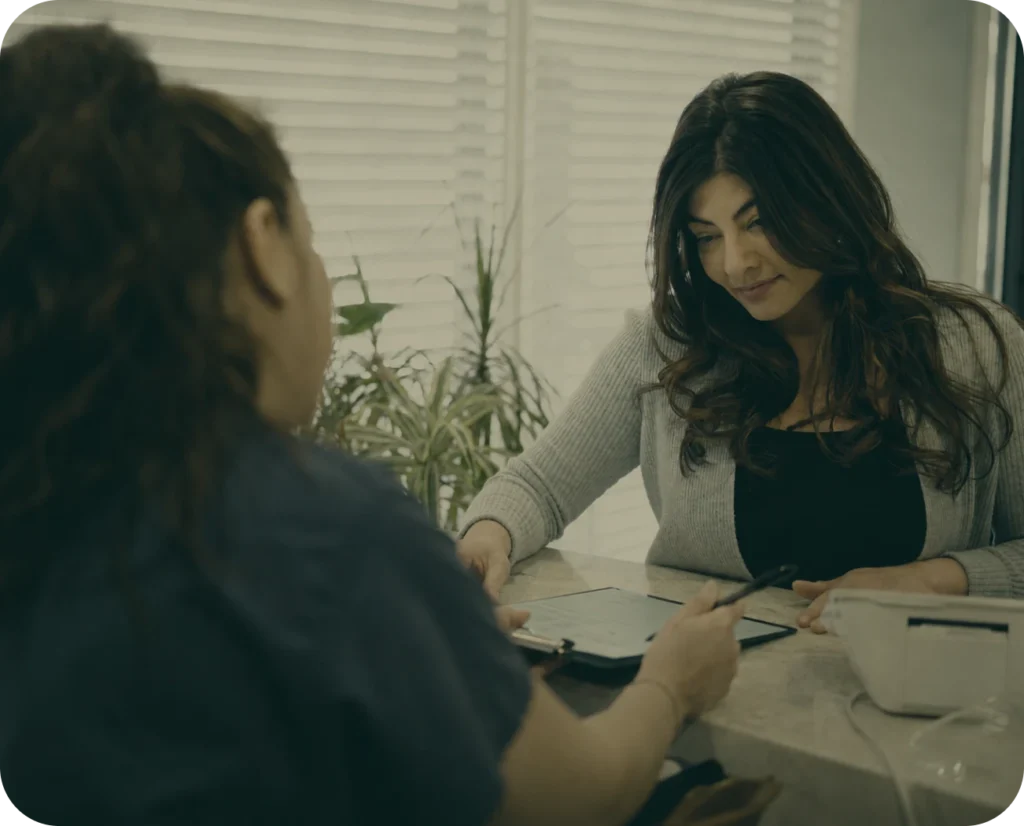
Someone reads down the schedule. At the third name, a question comes up. Is her maximum still open? Nobody knows. It gets written on a sticky note. Two names later, a new patient with a plan nobody recognizes. Another note. By the eleven o’clock column there are five open questions, and the huddle ends the way it usually ends, with a list of things to find out rather than a list of things to do.
Every one of those notes turns into an interruption later. The call happens at 8:40, while the patient is already seated. The answer arrives after the hygienist has finished. The treatment coordinator learns about a downgrade at 4:15, standing next to a patient holding a credit card.
The cost is not the phone call
A hold time is annoying but survivable. The real expense is that the question surfaces at the worst possible moment, when someone is mid-task and a patient is watching. That interruption pulls a person off the front desk, delays the next check-in, and pushes a decision into a hallway conversation.
It also shows up downstream. In Experian Health’s 2025 State of Claims survey of 250 healthcare professionals, missing or inaccurate data was the leading cause of denials at 50%, and incomplete or inaccurate patient registration data was cited by 32%, both up year over year. Forty-one percent of providers reported denial rates of 10% or higher. The sticky note that never got resolved becomes a denial six weeks later, when nobody remembers the context.
What a prepared huddle sounds like
When verification is finished before the meeting starts, the conversation changes shape. Instead of collecting questions, the team is making decisions.
The patient at 9:30 has $340 left on her maximum and needs a crown, so the discussion is whether to stage it across the plan year. The 11:00 has a frequency conflict on bitewings, six weeks short, so the front desk knows the number before she asks. The 2:00 has a posterior composite that will be paid at the amalgam rate, so the estimate already reflects it and nobody is surprised at checkout. The 3:15 terminated coverage on the first, which somebody needs to raise gently at check-in rather than discover at the end.
None of those are hard conversations. They are only hard when they happen late.
What to bring to the meeting
A useful huddle packet is short. For each patient on the schedule: remaining maximum and deductible status, frequency clearance on whatever is planned, any downgrade or alternate benefit provision that affects the estimate, secondary coverage if it exists, and a flag on anyone whose eligibility could not be confirmed.
That last category matters more than the rest. A patient you could not verify is not a problem to solve at the huddle, it is a decision to make: call them now, adjust the appointment, or proceed knowing the estimate is provisional. Deciding it at 7:50 is a strategy. Discovering it at 10:15 is a scramble.
One person should own the packet, and it should exist before anyone walks into the room. A huddle where the information is being assembled during the meeting is not a huddle, it is a work session that the clinical team is being made to attend. The packet also needs to cover same-day additions, because the patients who get squeezed in are disproportionately the ones nobody verified.
The part patients notice
Teams tend to frame verification as a back-office function, but patients experience it directly, through the confidence of the person talking to them. There is a difference between “your portion is $312” and “it should be around $300, but let me check and get back to you.” The second answer is honest, and it still costs you the case more often than the first.
When the huddle starts with answers instead of questions, the whole day inherits that. Fewer callbacks, fewer revised estimates, fewer conversations that begin with an apology. The meeting gets shorter too, which nobody complains about.
There is a secondary effect worth naming. Hygienists and assistants stop being asked to hold conversations they were never given information for. A hygienist who knows a patient’s periodontal maintenance frequency has already reset can raise it in the operatory, calmly, at the right moment.
The same hygienist without that information either avoids the subject or improvises, and neither serves the patient.
The work does not disappear. It moves to the night before, where it belongs, and where it can be done without a patient waiting on the other side of it.
Source
Experian Health, 2025 State of Claims survey (250 healthcare professionals) — missing/inaccurate data 50%; registration data 32%; 41% with denial rates ≥10%